Bushcraft & Wilderness Skills
Fire in the Rain: Ignition Methods and Tinders That Work When Wet
Almost everything written about how to start a fire in wet conditions focuses on the spark. That is the wrong end of the problem. A ferro rod works soaked; the sparks are burning metal at temperatures far above the ignition point of wood. What fails is the fuel — every stick in a wet landscape is carrying water, and water absorbs a large amount of heat before it will leave. So this guide is mostly about the twenty minutes before you strike anything: where dry wood still exists after three days of rain, how to manufacture dry surfaces with a knife, how much fuel you need staged before the first spark, and which tinders ignite when they are actually wet rather than merely cold. There is arithmetic here, because the arithmetic explains the failures. There is a drill at the end with a pass condition you either meet or do not. Where a figure is safety-critical or comes from a published agency, it is linked at the point of use. Where evidence is thin, we say so.
The short answer, before the reasoning
In wet conditions you do not find dry fuel. You make it, and you stage all of it before you strike.
In order:
- Roof the fire site and yourself first. A tarp, a rock overhang, a dense conifer, a slab of bark propped on sticks. Rain dripping into a young flame kills more attempts than any failure of ignition.
- Get the fire off the ground. Build a platform of two crossed layers of wrist-thick dead wood so the tinder sits 2-3 in (5-8 cm) above saturated soil.
- Stop picking wood up off the ground. Take standing dead wood and the dead branches still attached to living trees. Off the ground, wood sheds water; on the ground, it acts as a sponge.
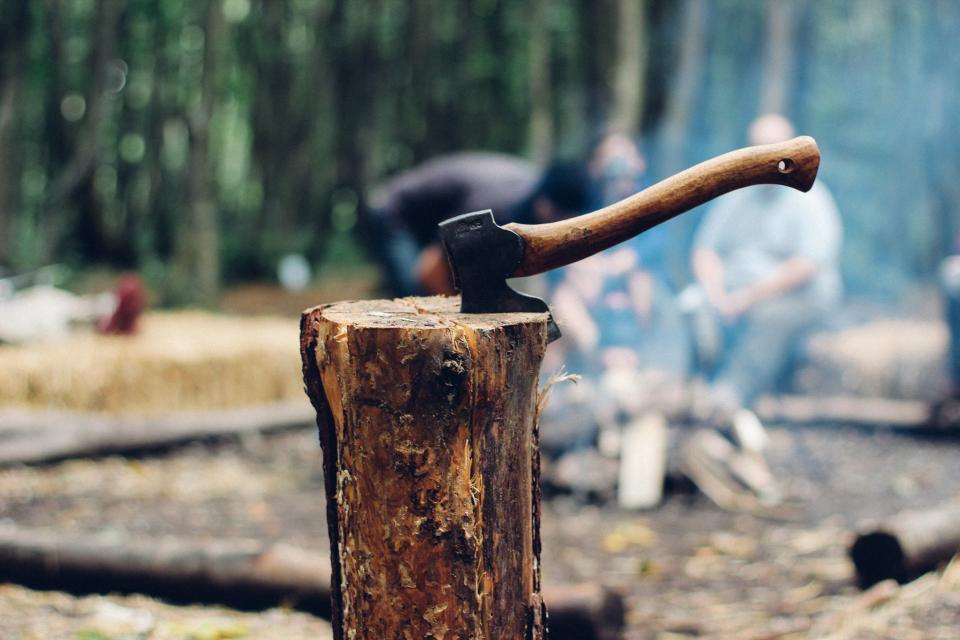
- Split everything. After days of rain the wet layer on standing dead wood is usually only a few millimetres deep. One split exposes a dry core. A feather stick cut from that core is dry tinder you manufactured on the spot.
- Carry tinder that ignores rain. Petroleum-jelly cotton, fatwood, birch bark, wax-impregnated commercial tinder. Carry three kinds in three separate places.
- Gather three times what you think you need. Wet fires die while you are away fetching kindling.
- Make the ferro rod your primary and the lighter your backup. A disposable butane lighter is a chemistry problem below about 40 °F (4 °C). A ferro rod is not.
If you do those seven things, ignition becomes routine. If you skip the fifth and sixth, no ignition source on the market will save the attempt. The rest of this page is why, with numbers.
Why wet fires fail: it is a heat budget, not a spark
A wet fire fails for a reason you can calculate. Water has to be heated to boiling and then vaporised before the wood underneath it can reach pyrolysis temperature, and vaporisation is expensive.
The constants are standard physics, not our measurements:
- Specific heat of water: 4.18 kJ per kg per °C
- Latent heat of vaporisation of water: about 2,260 kJ per kg — roughly five times the energy needed to heat the same water from freezing to boiling
- Wood begins meaningful pyrolysis around 400-570 °F (200-300 °C)
- Dry wood releases roughly 18-20 MJ per kg when it burns
Take one pencil-thick stick: 6 in (15 cm) long, about 3/8 in (10 mm) across, roughly 6 g total, at 25% moisture. That is about 1.5 g of water and 4.5 g of wood.
- Heat the water from 50 °F to 212 °F (10 °C to 100 °C): 1.5 g × 4.18 × 90 ≈ 0.6 kJ
- Evaporate it: 1.5 g × 2.26 ≈ 3.4 kJ
- Heat the wood itself to about 570 °F (300 °C): 4.5 g × 1.7 × 290 ≈ 2.2 kJ
Total: roughly 6 kJ for a damp stick against about 2 kJ for the same stick bone dry. Wet costs you three times the heat, and you have to supply it from a tinder flame that is measured in tens of kilojoules, not hundreds.
Now the other side of the ledger. A cotton ball worked through with about 2 g of petroleum jelly holds on the order of 80-100 kJ of chemical energy. Only a fraction of that — call it 10-20% in an open, breezy, rain-cooled setting — actually lands on the fuel above it. That leaves maybe 10-20 kJ of usable heat, which is two or three damp pencil sticks, or six to eight dry ones.
Two levers follow directly, and they are the whole craft:
- Cut the water. Splitting and feathering removes the wet outer layer entirely. A dry stick needs a third of the heat.
- Cut the mass. Mass goes with the square of diameter. Halving kindling from 3/8 in (10 mm) to 3/16 in (5 mm) cuts the energy per unit length by four times. This is why the answer to a struggling wet fire is always thinner wood, never more wood.
These are order-of-magnitude figures derived from published constants to show the shape of the problem. They are not results we measured in the field — see how we test for what we do and do not claim.
Where dry wood still is after three days of rain
Rain does not penetrate dead wood deeply. It saturates the ground, and it saturates anything lying on the ground. Everything else is a surface problem.
Take, in this order of preference:
- Dead branches still attached to a tree. The dead lower limbs of spruce, pine and fir are the classic wet-weather kindling. They are held clear of the ground, shielded by the canopy above them, and often resinous. Snap them off at the trunk.
- Standing dead trees and snags. The best fuel wood in a wet landscape. The outer inch may be punky; the core is usually sound and dry.
- Wood suspended off the ground in blowdown tangles, leaning against rocks, or arching clear of the soil.
- The undersides of downed logs and the sheltered side of root plates, where a tipped-up root mass makes a natural rain shadow.
Avoid:
- Anything lying flat on wet ground. It has wicked water along the grain, not just across the surface, and splitting will not reach a dry core.
- Live wood. Green wood typically runs 40-60% moisture content and will not carry a fire. For comparison, seasoned firewood is generally considered ready below 20%, and kiln-dried stock runs around 10-15%. The gap between 50% and 20% is the difference between a fire and a smoke generator.
- Moss and lichen. They hold water like a sponge. In rain they are decoration, not tinder.
The snap test. Hold a twig and bend it. Dry dead wood snaps cleanly with an audible crack. Damp wood bends, or peels and tears without a clean break, or breaks silently. Punky wet wood crumbles. This is a two-second check and it is a pass/fail: if a pencil-thick twig does not snap, it is not going in the first five minutes of your fire.
The species worth learning. Birch bark contains oily compounds (betulin and suberin) that burn even when the bark is soaked; papery outer strips peel off standing trees and dead birch in curls, and they will take a spark. Fatwood — resin-saturated pine heartwood, found in the stumps and branch knots of dead conifers — is the single most reliable natural tinder in the rain. Shaved into a pile of fine curls with a knife, it takes a ferro rod spark and burns with a sooty, persistent flame that resists both wind and drizzle. If you learn only two plant identifications for fire, make them these.
Tinders that work when wet, ranked honestly
A tinder has one job: turn a spark or small flame into enough sustained heat to dry and ignite the layer above it. In rain that means it must resist water, ignite from a low-energy source, and burn for long enough to matter.
Tier 1 — works soaked, carried in your pocket
- Petroleum-jelly cotton balls. Cheap, light, and the benchmark. Work the jelly through about two-thirds of the fibre and leave one end dry and teased open so it will catch a spark. Ten of them fit in a 35 mm film tin or small screw-top tin at roughly 1 oz (28 g). The jelly is the fuel; the cotton is the wick.
- Commercial wax or resin-impregnated tinder (cubes, sticks, compressed tabs). Heavier per unit, but nothing to prepare and they tolerate being crushed in a pack for a year.
- Fatwood. Natural, found on site, and the only Tier 1 option you can restock in the field. Shave it fine — a pile of curls the size of a golf ball — rather than trying to spark the solid stick.
- Birch bark. Free, abundant where birch grows, and functional when wet. Shred the outer papery layers.
Tier 2 — works damp, fails soaked
- Feather sticks cut from split, dry-cored wood. The most important skill on this page because it converts wet fuel into dry tinder with nothing but a knife.
- Dead conifer twig bundles. A fist-sized bunch of matchstick-thin dead twigs off a standing tree, held together and lit from underneath.
- Processed inner bark fibre (cedar, juniper, basswood), rubbed between the palms into a fine bird's-nest.
- Dry grass, seed down and cattail fluff taken from under an overhang. These flash in a second or two and need kindling waiting directly above them.
Tier 3 — do not rely on these in rain
- Paper, cardboard, leaves, dryer lint, untreated cotton. All absorb water freely. They are tinder in a dry garage, not in a downpour.
- Alcohol hand sanitiser. It will light, but the flame is pale to near-invisible in daylight, burns cool, and boils off in well under a minute. It can also mislead you into thinking a fire is established when nothing has caught.
- Char cloth. Superb with flint and steel, but it absorbs moisture instantly and it does not produce flame — only an ember that still needs a dry bundle.
How much. In dry conditions a golf-ball volume of tinder is enough. In rain, plan on a grapefruit-sized volume of processed material, plus at least one Tier 1 unit held back untouched as your second attempt. A single tinder unit is not a plan; it is one roll of the dice.
Ignition sources compared, with the cold-weather limits stated
Ferro rod — primary. A ferrocerium rod throws sparks of burning metal; manufacturers commonly cite temperatures around 3,000 °C (roughly 5,400 °F), far above wood's ignition point. It works after immersion, works at any temperature, works at altitude, and a 3/8 in (10 mm) rod carries thousands of strikes — more than you will use in years. Its limitation is specific: a ferro rod cannot light a stick. It can only light fine, fluffy or oil-bearing material.
Technique matters more than the rod. Bury the rod's tip in the tinder rather than showering sparks from above. Hold the striker still at about 90° to the rod and pull the rod back under it. That keeps the sparks landing in one place and stops you from scattering your tinder pile with the follow-through. New rods often ship with a protective lacquer — scrape it off before you need it.
Disposable butane lighter — backup, with a known failure temperature. This is chemistry, not opinion. n-butane boils at 31 °F (-0.5 °C) at sea level, and its vapour pressure falls steeply as temperature drops. Below roughly 40 °F (4 °C) a standard butane lighter becomes unreliable, and in freezing rain it may produce nothing but a wet click. Two mitigations: carry it in an inside pocket against your torso, and warm it in a closed fist for 60 seconds before use. If the flint wheel is wet, spin it 20-30 times against dry trouser fabric first. Carry a translucent lighter so you can see the fuel level.
Refillable jet/torch lighters. Hotter and genuinely wind-resistant, but the jets are sensitive to cold and to being carried dirty. Good as an accelerant for marginal tinder; poor as your only plan.
Stormproof matches. Manufacturers rate these at roughly 10-15 seconds of burn and claim they relight after immersion, and they cannot be blown out. The weak points are that the supply is finite — a 25-match box is exactly 25 attempts — and that the striker is the part that fails when wet. Seal spare strikers separately from the box.
9V battery and 0000 steel wool. A legitimate backup that works with damp wool and uses a battery you may already be carrying for a headlamp. Store the wool well away from any battery terminal; loose steel wool in a pack is a genuine fire hazard.
Lens and solar ignition. Requires direct sun. In rain it is not an option. Say so and move on.
Friction fire (bow drill, hand drill). Worth learning, and it is not your wet-weather answer. Every component — spindle, hearth board, bearing block, tinder bundle — must be dry, and producing a coal in sustained rain with cold hands is a low-probability event. Treat it as a skill for a dry camp or a long-term scenario, not as the method you fall back on at dusk in a storm.
What to carry: a ferro rod on a tether, two lighters in separate places (one against your body), sealed stormproof matches, and prepared tinder in at least two locations. That is redundancy across failure types, not three copies of the same failure. The same logic drives our 72-hour emergency kit build.
Build the fire site before you make a spark
In the rain, site preparation is most of the work and it takes longer than people expect.
Roof. Put something over the fire site before anything else. A tarp works if it is at least 3-4 ft (1 m) above the flames and offset so rising heat and sparks do not sit against it — synthetic fabric melts fast and silently. A rock overhang, a dense spruce, or a sheet of bark propped on two sticks all work. Roof yourself too: you cannot do fine knife work while rain runs down your sleeves.
Platform. Lay two crossed layers of wrist-thick dead wood covering about 18 × 18 in (45 × 45 cm). This lifts the tinder 2-3 in (5-8 cm) off saturated ground. Without it, the ground does two bad things: it conducts heat away, and it releases steam upward into the exact spot where you need dry air.
Wind. Leave a gap of a few inches on the windward side to feed air in, and block the other three sides with a pack, a log, or a low reflector wall. A wet fire needs more airflow than a dry one, because it is producing steam that has to leave.
Lay. Start as a tight tipi of matchstick-thin kindling built around and over the tinder — the tipi shape maximises radiant heat feeding back into the centre, which is exactly what you need during the first two minutes. Once pieces reach pencil thickness, convert to a lean-to against a split backlog. A lean-to tolerates being fed without collapsing and keeps a dry face pointed at the heat.
Bark side down, split face to the flame. Bark resists heat and sheds water; the split face is dry and porous. Orientation is free and it matters.
Then the second fire. The moment flame is stable, stack your next round of fuel around the perimeter, 6-12 in (15-30 cm) from the flames, split faces inward. Rotate the pieces every few minutes. Your first fire's real job is to dry the fuel for your second fire. This is the step that separates a fire that lives for hours from one that dies twenty minutes in, and it is the step almost nobody photographs.
Do not leave it. Once lit, a wet fire needs attention every 30-60 seconds for the first ten minutes. If you have to go and fetch wood at that point, you gathered too little. Which brings us to quantities.
How much wood, in numbers
"Gather more than you think" is useless advice because it has no units. Here are units. These are the volumes to have stacked and sorted under cover before you strike, for a fire you intend to keep for an hour in wet conditions.
- Tinder: a grapefruit-sized volume of processed material, plus one untouched Tier 1 unit in reserve.
- Matchstick-thin, under 1/8 in (3 mm): two double handfuls — a bundle you can just close one hand around, about 12 in (30 cm) long.
- Pencil-thick, 1/4-3/8 in (6-10 mm): a bundle roughly the diameter of your forearm and 18 in (45 cm) long.
- Thumb-thick, about 3/4 in (20 mm): twice that volume.
- Wrist-thick, 1.5-2 in (40-50 mm): as much as two trips will carry, plus the platform wood.
Time budget. In the rain, expect 20-40 minutes of gathering, splitting and feathering before the first spark. If you struck a spark after five minutes of collecting, you are going to be hunting for kindling in the dark with a dying fire behind you.
The size-jump rule. Never more than roughly double the diameter per step. The commonest single failure in wet-weather fire is jumping straight from burning tinder to thumb-thick wood. Remember the arithmetic: mass scales with the square of diameter, so doubling diameter quadruples the heat the new piece demands. A fire that is coping fine will die instantly under a piece one size too large and slightly damp.
Rule of thumb for a night. Sorting and splitting a night's wood before dark, under a tarp, is worth more than any piece of gear. Wood you split at 4 p.m. and stack under cover is materially drier at 9 p.m. Wood you collect at 9 p.m. in the rain is not.
The Wet-Weather Fire Check: a drill with a pass condition
Skills beat stockpiles, and a skill you have not tested under load is a belief. This drill is designed so that you cannot fool yourself about whether you have the skill.
Conditions. Run it after at least 12 hours of rain, or, if you cannot wait for weather, soak both a 3 × 3 ft (1 × 1 m) patch of ground and your intended wood pile with 5 gallons (19 L) of water 30 minutes beforehand. Colder than 50 °F (10 °C) if you can arrange it. Outdoors, in the open, under a tarp you erect yourself.
Kit allowed. One knife. One ferro rod. One prepared tinder unit. The clothing you would actually be wearing. Whatever fuel exists within 100 ft (30 m). No paper, no lighter, no liquid fuel, no second tinder.
Clock. Starts when you arrive at the site with nothing prepared.
PASS CONDITION: within 20 minutes of the start, you have a fire burning thumb-thick — about 3/4 in (20 mm) — wood continuously for 10 minutes, with no more than two interventions during that 10 minutes.
Anything else is a fail, including a beautiful fire at minute 25 and a fire that needs constant blowing to survive. Interventions means touching the fire at all: feeding, adjusting, blowing.
Record the failure stage. There are only four, and knowing which one is yours tells you what to practise:
- Tinder would not ignite — your tinder preparation or ferro rod technique.
- Tinder burned out without catching kindling — kindling too thick, too wet, or not staged and waiting.
- Fire would not step up to thumb-thick — you skipped a size, or you went too fast.
- Fire drowned or smothered — no roof, no platform, or too much fuel added at once.
Progressions, in order. Repeat wearing gloves. Repeat with one hand tucked into your jacket, simulating an injury. Repeat after standing still in the cold for 30 minutes first, so your hands are genuinely degraded — this one is the revelation. Repeat with no knife, only what you can break by hand.
The standard is not one pass. Pass three times, on three different days, in three different locations, with different wood. Then it is a skill.
We publish the protocol, not invented scores — our approach to method and measurement is set out in how we test. Run this drill only where fires are legal and safe; see the safety section below.
Cold hands, and the decision that comes before fire
Fire is often the wrong first move, and that is worth saying plainly on a page about fire.
If you are wet and cold, the fastest route to a stable core temperature is almost always shelter, dry insulation, wind protection, and calories — not a fire. A fire in wet conditions takes 30-60 minutes of competent work. A dry layer and a windproof shell take two minutes. The CDC's guidance on hypothermia and cold exposure lists the warning signs: shivering, exhaustion, confusion, fumbling hands, memory loss, slurred speech, drowsiness. Fumbling hands appears on that list, and it is exactly the capability fire-making needs. Build the shelter, get out of the wind, get dry layers on, and then build the fire from a position of stability.
Manual dexterity degrades well before you feel endangered. Plan for that:
- Tether the ferro rod to its sheath with 6 in (15 cm) of cord. A dropped rod in leaf litter at dusk is a lost rod.
- Use a tin you can open with your teeth, or a lid you can lever with a knife. Small zip bags are not cold-hands hardware.
- Prepare tinder early. Cut two feather sticks during the walk, while your hands still work, and put them inside your jacket. Preparation done at 3 p.m. is worth ten times the same work at 7 p.m.
- Keep the lighter against your body, not in a pack lid.
Check the forecast before you commit to a route; the National Weather Service publishes wind chill and precipitation timing that will tell you whether you are heading into a two-hour shower or a two-day system. That changes the fuel-gathering decision more than any gear choice.
Once the fire is going, its highest-value job may not be warmth. It is boiling water. The EPA's emergency disinfection guidance calls for a rolling boil of 1 minute, extended to 3 minutes above 6,500 ft (2,000 m). Our full treatment of that is in how much water to store per person, and the cold-injury side of this belongs with the wilderness first aid kit.
Common mistakes and failure modes
Ranked roughly by how often they are the actual cause of a failed wet-weather fire.
- Striking too early. The dominant failure. You have a lit tinder bundle and are now hunting for kindling in the rain. Everything else on this list is downstream of this one.
- Collecting fuel from the ground. Ground wood in wet weather has wicked water along the grain. Splitting it will not save it. Take standing dead and dead-attached branches.
- Searching for dry wood instead of making it. There is no dry wood on the surface after two days of rain. There is dry wood 5 mm inside almost every dead stick you can reach.
- Skipping a size. Tinder to thumb-thick is a quadruple jump in heat demand. Add the pencil-thick stage you thought you could skip.
- One tinder unit as the whole plan. If the first one fails you should still have two attempts left, in different pockets.
- No platform. A fire on saturated soil steams itself out from below and nobody notices because the smoke looks like smoke.
- No roof. A single drip falling onto the ignition point is enough at minute one.
- Smothering. Adding a double handful of damp wood to a young fire. Add one piece at a time and listen — hissing means that piece is drinking your heat budget. Pull it back to the perimeter and let it dry.
- Blowing wrong. Short sharp puffs scatter embers and cool the fire between breaths. Get low, aim at the base of the ember, and blow long and steady. Stop as soon as flame appears.
- Assuming the lighter works. At 25 °F (-4 °C) a butane lighter that lived in your pack lid overnight may produce nothing at all. Test it before you need it, and keep it warm.
- Reaching for liquid fuel. Petrol vapour ignites explosively and the flame is gone in seconds without transferring useful heat into damp wood. Never pour any fuel onto an existing fire. Alcohol gel burns with a near-invisible daylight flame — a burn hazard and a false signal of progress.
- Untested gear. A ferro rod still wearing its factory lacquer will not spark. A dull knife will not cut a feather stick. A striker card stored loose in a wet pocket is a dead striker. Find these out at home.
- Leaving the fire to fetch more wood. If you must, bank the fuel over it and be back inside a minute. Better: do not be in that position.
One honest limitation: in sustained, heavy, wind-driven rain with no natural shelter and no carried tinder, a fire may simply not be achievable in a useful timeframe. If that is your situation, shelter and insulation are the answer, and pretending otherwise is how people get into trouble.
Legality, carbon monoxide and putting it out
Three things on this page can hurt you or cost you a fine, and all three are jurisdiction-dependent or medically serious.
Fire restrictions are local and they are not lifted by rain. Burn bans, stage restrictions, permit requirements and outright prohibitions vary by land manager, by county and by season, and wet ground does not automatically make a fire legal. Check with the agency that manages the land before you light anything. Ready.gov's wildfire guidance and National Weather Service fire-weather products are the right starting points, but the binding rule is always the local one. Practise your drills where fires are permitted.
Never burn fuel inside an enclosed space. Not in a tent, not in a vehicle, not in a snow shelter, not in a closed garage. Carbon monoxide is colourless, odourless and kills people who feel merely sleepy. The same rule governs charcoal, camp stoves, lanterns and generators at home: the CDC's carbon monoxide guidance is explicit that generators and charcoal must stay outdoors and well away from windows, doors and vents — the commonly published distance for generators is at least 20 ft (6 m). If you are heating a structure during an outage, read our backup power guide before improvising.
Site containment. Clear the ground to mineral soil for about 3 ft (1 m) around the fire. Check for overhanging branches within 10 ft (3 m). Do not build on peat, deep duff or root mats: those can carry fire underground, smoulder for days, and re-emerge somewhere you are not. Wet surface ground does not prevent this.
Putting it out. Drown it with water, stir the ashes and embers with a stick, drown it again, then feel the whole area with the back of your hand. If it is too hot to touch, it is too hot to leave. Budget a gallon (3.8 L) or more; a fire that has been burning for hours holds a surprising amount of heat in the soil beneath it.
Nothing on this page is legal, medical or professional advice, and conditions in the field vary in ways no article can anticipate. Read the disclaimer and use your own judgement.
The fire module we carry, and what we measure
A wet-weather fire kit is small, light and cheap. Nothing here is exotic, and the total cost sits in the low tens of dollars rather than the hundreds.
- Ferro rod, 3/8 in (10 mm) or larger, with a dedicated carbon-steel or carbide striker. Roughly 2 oz (57 g). The larger diameter throws a heavier spark shower, which matters when your hands are cold and you get fewer good strikes.
- Two butane lighters, in different places, one against your body.
- Ten petroleum-jelly cotton balls in a small screw-top tin, about 1 oz (28 g).
- Two or three fatwood sticks, 1-2 oz (28-57 g).
- Stormproof matches with a sealed spare striker, kept as the third option and not the first.
- A knife that can baton and feather — a fixed blade or a genuinely robust folder. This is the item that turns wet wood into dry wood, so it is not the place to save weight.
Call it 8-12 oz (230-340 g) for the module. It lives in the same logic as the rest of the 72-hour emergency kit: redundancy across failure types, and every ounce justifying itself.
What we record when we test fire gear. We publish the protocol and its conditions, not tidy numbers with the conditions removed: ambient temperature and wind, precipitation in the preceding 24 hours, wood species and moisture content where a meter is available, tinder type and mass, number of strikes to ignition, time from first strike to self-sustaining flame, and — most importantly — every attempt that failed and why. Rational Survivor is a new publication, most of our testing runs on single samples, and a single sample supports only certain kinds of claim. Where that limits what we can honestly say, we say it in the same sentence as the result. The full standard is in how we test and in our editorial policy.
Next, work through the rest of bushcraft and wilderness skills, or start with the drill above this weekend. A fire you lit in the rain once is worth more than a shelf of gear you have never opened.